WeaveGrid: Lifecycle Marketing & EV Program Growth

At WeaveGrid, I led lifecycle marketing and customer communication strategy for utility EV charging programs across onboarding, enrollment, retention, and long-term customer engagement.
My work focused on improving EV driver participation and retention through lifecycle campaigns, onboarding optimization, recurring engagement experiences, and utility partner communications.
Projects included:
Tesla reauthorization campaigns
Utility partner onboarding and registration optimization
Customer retention initiatives
Weekly charging summary experiences
Lifecycle communication systems for long-term engagement
Core Focus Areas
Lifecycle Marketing & Customer Engagement
Lifecycle communication strategy supporting EV driver onboarding, enrollment, retention, recurring engagement, and long-term participation across utility partner programs.
Customer Retention & Re-Engagement
Retention-focused lifecycle campaigns and recurring engagement experiences designed to reduce drop-off, recover disconnected users, and maintain participation in utility EV programs.
Utility Partner Communications
Co-branded customer communication systems supporting utility partner onboarding, recruitment campaigns, and program education initiatives.
Conversion Optimization & Lifecycle Strategy
Lifecycle messaging optimization through content restructuring, iterative testing, customer behavior analysis, and performance-driven communication strategy.
01 — Tesla Reauthorization Emails
Challenge
WeaveGrid’s platform relied heavily on Tesla driver participation across utility EV charging programs.
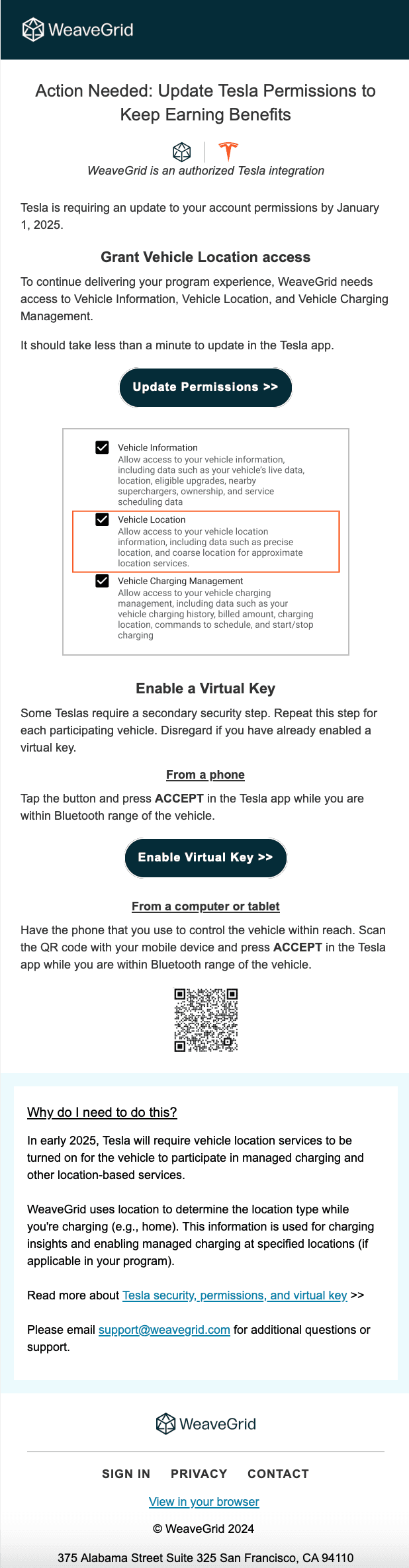
When Tesla updated its integration requirements, participating drivers were unexpectedly disconnected and required to reauthorize their accounts, update permissions, and complete a multi-step virtual key setup process to remain enrolled.
The update created significant customer retention and revenue risk with only about one week of advance notice before drivers would lose connectivity and program access.
The challenge required rapidly deploying lifecycle communication campaigns across approximately 18 utility partner programs while:
simplifying a technically complex process
addressing customer privacy and security concerns
communicating urgent action requirements without creating panic
coordinating approvals across multiple utility stakeholders
adapting messaging strategy based on real-time campaign performance
Approach
I developed a lifecycle communication strategy focused on reducing friction and increasing successful reauthorizations under an accelerated timeline.
The campaign positioned WeaveGrid as an authorized Tesla integration and used simplified step-by-step instructions, visual guidance, FAQs, and clear CTAs to help drivers complete the reauthorization process.
After launch, I analyzed campaign performance data and iterated quickly on messaging strategy, FAQs, subject lines, and urgency framing to address customer hesitation and drop-off behavior.
Subsequent campaigns incorporated:
expanded privacy and security FAQs
progressively stronger urgency messaging
clearer explanations of program benefits drivers would lose if disconnected
refinements to CTA hierarchy and instructional content based on customer feedback and campaign performance
I also developed a post-campaign customer feedback survey to better understand drop-off behavior and inform future lifecycle strategy improvements.
Impact
The campaign achieved more than 70% conversion, successfully retaining the majority of participating Tesla drivers despite the complexity of the reauthorization process.
Clear instructional content, rapid campaign iteration, and trust-focused communication helped drive strong customer action during a high-friction enrollment period.
The post-campaign survey generated customer insights that informed future lifecycle strategy improvements and stakeholder reporting.
02 — Utility Partner Registration Optimization
Challenge
A major U.S. utility provider’s EV recruitment email underperformed because the financial value wasn’t immediately clear and the content was difficult to scan quickly, particularly on mobile.
Approach
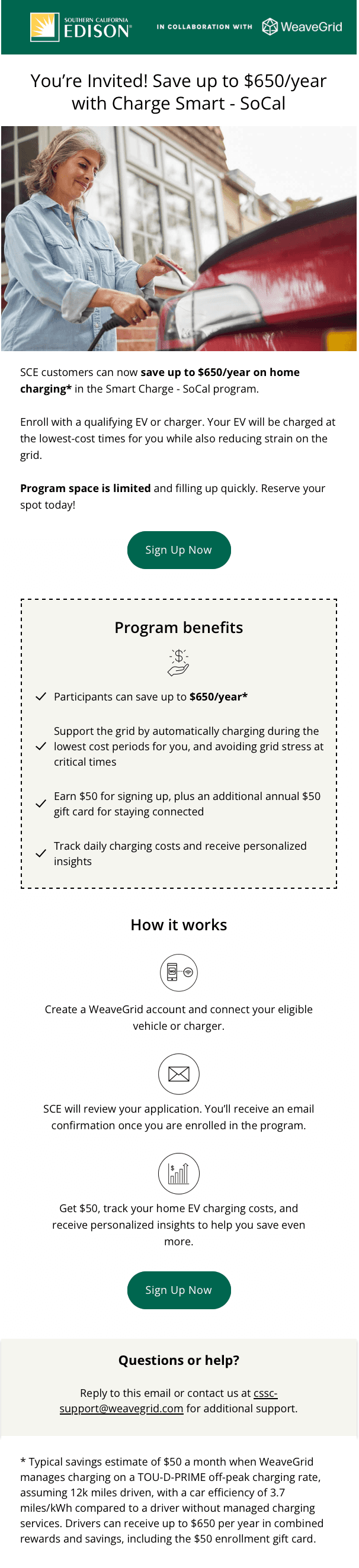
I repositioned the email around immediate financial value, then restructured the content to improve clarity and mobile-first scanning.
Key changes included:
shorter paragraphs and clearer information hierarchy
section-based organization for easier navigation
benefits-focused messaging
more direct, action-oriented CTAs
reducing friction for users scanning quickly on mobile
The revised structure made the program’s value easier to understand while improving readability and usability.
My Work
The original email can’t be shared due to client ownership restrictions.
This representative example reflects the messaging strategy and content structure of the original campaign.
The sample shown here was fully written, designed, and built by me.
Impact
Increased EV driver registrations by 8x and helped establish an ongoing creative partnership with the client.
03 — Rate Code Enrollment Optimization
Challenge
Certain utility programs required customers to confirm their utility rate code before enrollment could be completed.
Existing campaigns relied on customer support teams to manually contact drivers and request their rate code over email, creating operational overhead, slowing enrollment, and introducing additional customer friction.
Approach
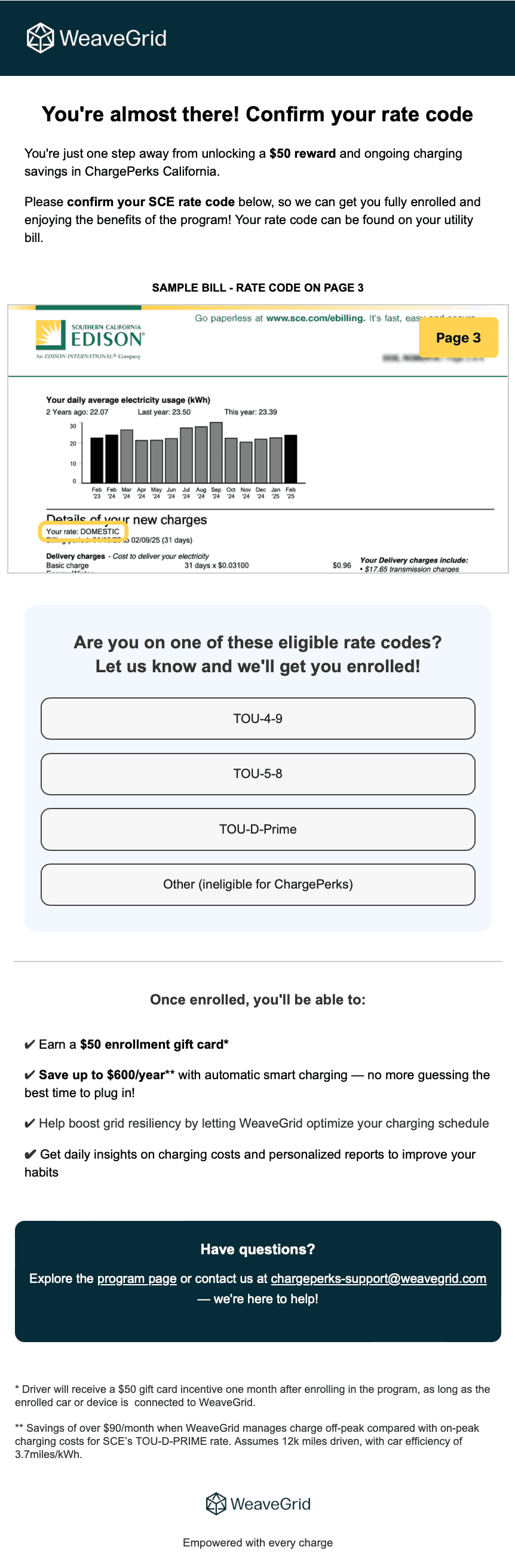
I redesigned the enrollment experience to allow customers to confirm their rate code directly from the email using an embedded survey workflow integrated with SurveySparrow.
The experience guided customers to identify their rate code from their utility bill and submit it without requiring manual email replies or customer support intervention.
The campaign also reinforced program value through clear savings messaging, enrollment incentives, and onboarding education designed to reduce drop-off during enrollment.
Impact
The new workflow eliminated the need for manual customer support outreach by allowing drivers to confirm their rate code directly within the enrollment experience.
This streamlined rate code collection, reduced operational overhead, and simplified enrollment for utility EV programs requiring rate verification.
04 — Charge Summary Emails

Challenge
As WeaveGrid’s EV programs expanded, the company needed to create ongoing value for drivers beyond the initial enrollment incentive.
Long-term participation depended on keeping drivers connected to the platform and engaged with the program over time.
If drivers disconnected their vehicle or stopped engaging, it directly impacted program participation and recurring revenue.
An early product concept was to create a recurring customer communication that provided drivers with personalized charging insights, behavioral trends, and energy optimization guidance based on their weekly charging activity.
Approach
I developed the first version of WeaveGrid’s dynamic Weekly Charging Summary email — the company’s earliest lifecycle communication product.
The experience combined personalized charging data, behavioral insights, and educational content designed to help drivers better understand charging habits, savings opportunities, charging flexibility, and grid impact.
My work included:
designing, building, and writing copy for the original experience and subsequent iterations
implementing dynamic content placeholders and personalized charging data modules
developing behavior-based messaging tied to driver activity
transitioning the experience from a manually deployed campaign into a fully automated recurring lifecycle flow
collaborating on ongoing iteration and optimization based on customer feedback and engagement trends
Over time, the product evolved through multiple iterations informed by usability learnings, engagement data, and recurring driver feedback.
Impact
The Weekly Charging Summary consistently achieved ~80% open rates and strong recurring engagement throughout my time at WeaveGrid.
The experience became one of the company’s most valuable customer-facing lifecycle products and was later incorporated into utility partner sales enablement materials.
Drivers used the summaries to better understand charging behavior, identify savings opportunities, and make charging decisions that helped reduce grid stress during peak demand periods.
In customer surveys, the Weekly Charging Summary was consistently cited as one of the most valuable program benefits outside of financial incentives.